
There are hundreds of knots. You need about ten. Learn these ten well — know them by feel in the dark — and you have all the knot knowledge required for practical preparedness, camping, and emergency use.
Each knot has specific applications. Using the right knot for the job makes the difference between a connection that holds under load and one that slips, jams, or fails.
The Ten Essential Knots:
1. Bowline:
Creates a fixed loop at the end of a rope that won’t slip under load and can be untied even after heavy loading. Often called the king of knots. Used for: rescue loops, securing lines to fixed points, creating a loop to clip a carabiner through. Memory device: the rabbit comes out of the hole, goes around the tree, and back down the hole.
 2. Clove hitch:
Two half hitches around a post or rail. Quick to tie, adjustable, easily released. Used for: starting lashings, temporarily securing a line to a post, securing a boat to a dock cleat. 3. Square knot (reef knot):
Joins two ends of the same rope to close a bundle. Simple, flat, and secure for this purpose. Not reliable for joining two different ropes under load. Used for: bandages, closing bundles, joining the same line.

4. Sheet bend:
Joins two ropes of different diameters reliably. What the square knot can’t do. Used for: joining paracord to a heavier line, connecting two ropes of different sizes.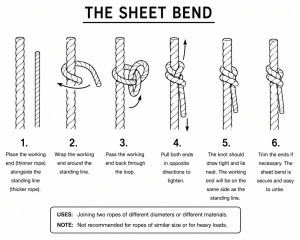
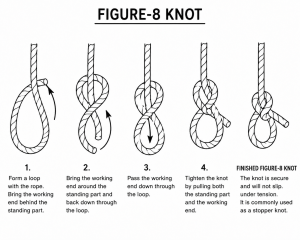
5. Figure-eight:
A stopper knot that prevents a rope from pulling through a hole or fitting. The fundamental stopper in climbing and rigging. Used for: preventing rope ends from pulling through pulleys, the basis for the figure-eight follow-through used in climbing harness attachment.
 6. Figure-eight follow-through:
Ties a secure loop around any object by threading the rope through the object and retracing the figure-eight. The standard method for attaching a climbing rope to a harness. Used for: attaching a rope directly to a fixed point, creating a loop around an anchor.
 7. Prussik hitch:
A friction hitch that grips tightly under load but slides freely when unloaded. Used for: ascending a fixed rope, creating a backup on a rappel, improvised rope ascenders.
8. Trucker’s hitch:
Creates a mechanical advantage (3:1) for tensioning a line — useful for securing loads, tensioning tent guy lines, and lashing gear. The go-to knot for securing cargo. 9. Taut-line hitch:
An adjustable loop that slides but holds under tension. Used for: tent guy lines that need adjustment, any situation where you need to adjust tension without untying.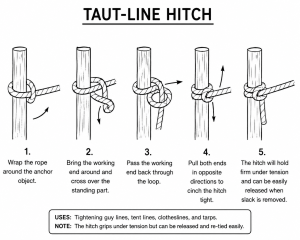
10. Timber hitch:
Used to drag a log or attach a rope to a cylindrical object. The more tension applied, the tighter it grips. Used for: dragging timber, attaching a tow line to a log or post.

How to learn them:
Each knot takes about twenty minutes to learn from a diagram and about five practice sessions spread over a week to truly internalize. YouTube videos are excellent for learning knots because you can see the motion in real time. Practice with actual rope, not just by watching. Tie each knot ten times until the motion is automatic. Review them periodically — knot knowledge is perishable.
Keep a short length of paracord in your pocket or bag specifically for practice.